
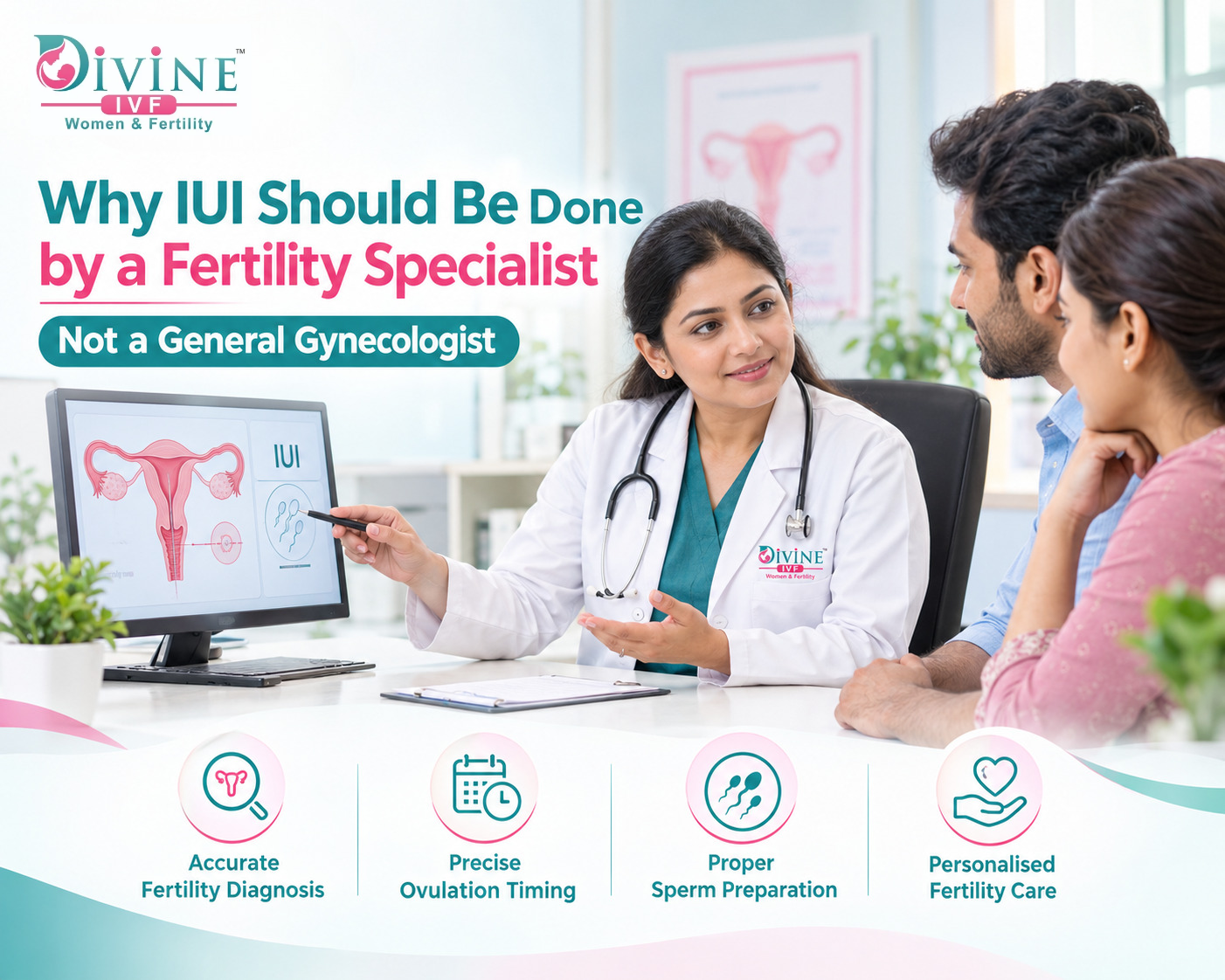
Why IUI Should Be Done by a Fertility Specialist — Not a General Gynecologist
Introduction
If you and your partner have been trying to conceive for a while, there is a good chance someone — a friend, a family member, or even your regular gynecologist — has suggested IUI. Intrauterine insemination is one of the most commonly recommended first-line fertility treatments, and rightly so. It is less invasive than IVF, more affordable, and for the right candidate, it can work beautifully.
But here is the part most people miss: IUI is not a one-size-fits-all procedure. Its success depends far less on the procedure itself and far more on who is planning it, when it is timed, and why it is being recommended in the first place.
And that is exactly why IUI should be done by a fertility specialist — not a general gynecologist.
At Divine IVF, Noida, Dr. Mandavi Rai has guided over 3,000 parenthood journeys in 15+ years of dedicated fertility practice. In this blog, we will explain — honestly and clearly — why the person performing your IUI matters more than you might think.
First, a Quick Understanding of What IUI Actually Involves
IUI is a procedure where washed and concentrated sperm is placed directly into the uterus around the time of ovulation. The goal is simple: shorten the distance between sperm and egg, and give the best-quality sperm a fair chance.
Sounds straightforward, right? It isn't.
A successful IUI depends on several moving parts working together:
- Confirming the right diagnosis — Are the fallopian tubes open? Is the sperm count and motility adequate? Is ovulation actually happening?
- Ovulation induction and trigger timing — The insemination must happen within a precise window.
- Semen preparation — Poor washing technique can damage sperm or reduce its fertilising ability.
- Follicle monitoring — Too many follicles risks multiples; too few risks failure.
- Knowing when to stop — If three IUI cycles fail, continuing blindly wastes time and money.
Each of these steps requires fertility-specific training. A general gynecologist is trained to manage women's health broadly — pregnancy care, menstrual issues, infections, surgeries. Fertility is a subspecialty, and IUI sits squarely inside it.
Why a Fertility Specialist Delivers Better IUI Outcomes
1. A Fertility Specialist Finds the Real Reason First
This is the single biggest difference.
A general gynecologist may recommend IUI simply because you haven't conceived. A fertility specialist investigates why you haven't conceived — before suggesting anything.
At a dedicated fertility clinic, your evaluation typically includes:
- Ovarian reserve testing (AMH, antral follicle count)
- Tubal patency assessment (HSG or laparoscopy if needed)
- Semen analysis with strict WHO criteria
- Thyroid, prolactin, and hormonal profiling
- Assessment for endometriosis, PCOS, or uterine factors
Why does this matter for IUI? Because IUI only works when it is the right treatment for the right diagnosis. If your fallopian tubes are blocked, IUI is a waste of time. If your partner has severe male factor infertility, IUI may never succeed and IVF with ICSI is the correct path. If you have untreated endometriosis, ovulation induction alone won't solve the problem.
A fertility specialist knows when IUI is appropriate — and, just as importantly, when it isn't.
2. Precise Ovulation Timing Makes or Breaks an IUI Cycle
IUI has a narrow window of opportunity. Insemination needs to happen roughly 24–36 hours after the LH surge or trigger shot. Miss that window, and the cycle fails — no matter how well everything else was done.
Fertility specialists use:
- Serial ultrasound follicle monitoring
- Serial hormone tracking where required
- Carefully planned trigger injections
- Experience-based judgement on the optimal insemination moment
General gynecology practices often lack the ultrasound frequency and protocol discipline that IUI timing demands. The result? Cycles that were "technically done" but poorly timed.
3. Ultrasound-Guided IUI — A More Precise, Visualised Approach
One important factor that distinguishes fertility-focused IUI care is whether the procedure is performed under ultrasound guidance.
At Divine IVF, Noida, Dr. Mandavi Rai performs IUI under ultrasound guidance, allowing the doctor to visualise the uterus and guide catheter placement during the procedure. This provides real-time visual assistance rather than relying solely on anatomical landmarks and tactile feedback.
Why does ultrasound guidance matter during IUI?
- Real-Time Visualisation: Helps the doctor visualise the uterus and guide the catheter during insemination.
- Guided Catheter Placement: Provides visual assistance during catheter advancement, which may be particularly helpful in technically difficult cases.
- A More Controlled Approach: Allows the procedure to be performed with greater visual awareness of the uterine anatomy.
- Specialist-Led Care: Reflects a fertility-focused approach in which the procedure is planned and performed with attention to individual anatomy and clinical requirements.
While conventional IUI can also be performed without ultrasound guidance, ultrasound-guided IUI offers an additional level of visual assistance during catheter placement. The appropriate approach depends on the patient's anatomy and clinical circumstances.
At Divine IVF, Dr. Mandavi Rai combines dedicated fertility expertise with ultrasound-guided IUI to provide personalised, carefully planned fertility care.
4. Better Semen Preparation — A Skill in Itself
Many people assume the sperm washing part is standard everywhere. It isn't.
Proper semen preparation involves:
- Density gradient or swim-up techniques
- Removing seminal plasma, debris, and dead sperm
- Concentrating motile, morphologically normal sperm
- Handling samples with strict quality control
A fertility clinic's andrology lab is designed around this single task. In a general gynecology setup, sperm preparation is often outsourced or done in a general lab without fertility-specific expertise. This directly impacts how many good sperm reach the uterus.
5. Fertility Specialists Know When to Escalate
Here's a scenario we see often: a couple completes five or six IUI cycles at a general clinic, each one failing, with no change in protocol or plan.
A fertility specialist reviews the cycle honestly after each attempt:
- Was ovulation adequate?
- Was the sperm preparation optimal?
- Was the timing correct?
- Is there an undiagnosed factor we've missed?
If three well-planned IUI cycles don't work, a specialist will say so — and recommend IVF or another approach rather than repeating the same failed cycle. That honesty protects your time, your money, and your emotional health.
6. Emotional and Ethical Care Matters More Than You Think
Infertility is exhausting. Failed cycles take a real toll. A fertility specialist doesn't just manage the procedure — they manage expectations, explain probabilities honestly, and support you through the disappointments.
At Divine IVF, the entire care philosophy is built on this. As Dr. Mandavi Rai puts it:
"There is no one-size-fits-all path to parenthood. My role is to understand, guide and support you with the right care, at the right time."
This is not the kind of care a general gynecologist, juggling pregnancy check-ups and surgeries, can consistently provide.
Fertility Specialist vs General Gynecologist: A Clear Comparison
| Parameter | General Gynecologist | Fertility Specialist |
|---|---|---|
| Primary training | Women's health, obstetrics, surgery | Reproductive medicine subspecialty |
| Fertility evaluation depth | Basic | Comprehensive, both partners |
| Ultrasound monitoring for IUI | Limited frequency | Cycle-specific, protocol-driven |
| Ultrasound-guided IUI | Rarely available | Performed with real-time visualisation |
| Semen preparation | Often outsourced | In-house andrology lab |
| IUI timing precision | Variable | Trigger-based, closely monitored |
| When IUI fails | Repeat or refer | Structured escalation to IVF/ICSI |
| Emotional counselling | General | Fertility-specific |
The difference isn't about competence — it's about focus. A general gynecologist is excellent at what they do. Fertility is simply a different discipline.
What to Look For Before Choosing Where to Get IUI Done
Before you book your IUI, ask these questions:
- Who will plan and monitor my cycle — the doctor personally, or a rotating team?
- Is there an in-house lab for semen preparation?
- Is IUI performed under ultrasound guidance?
- How many ultrasound scans will I have before insemination?
- What happens if three IUI cycles fail?
- Is the doctor formally trained in reproductive medicine?
If the answers are vague, that's information worth having.
At Divine IVF in Sector 76, Noida, every fertility plan is doctor-led — shaped directly by Dr. Mandavi Rai rather than a rotating team. The clinic offers comprehensive IUI and IVF services, an in-house advanced lab, ultrasound-guided IUI, and complete male and female fertility evaluation under one roof.
When IUI Is the Right Choice — And When It Isn't
A fertility specialist will help you understand this honestly:
IUI may be suitable if:
- You have mild male factor infertility
- You have ovulation disorders like PCOS
- You have unexplained infertility with normal tubes
- You have cervical factor or mild endometriosis
- Donor sperm is being used
IUI is usually not the right path if:
- Both fallopian tubes are blocked
- There is severe male factor infertility
- There is significant endometriosis or uterine pathology
- You are above a certain age with low ovarian reserve
Only a proper fertility workup can tell you which category you fall into. Guessing wastes precious months.
Why Choose Divine IVF for IUI in Noida
- 15+ years of dedicated fertility and IVF experience
- 3,000+ parenthood journeys supported
- Doctor-led care — every plan shaped personally by Dr. Mandavi Rai
- Ultrasound-guided IUI performed with real-time visualisation
- Fellowship in Reproductive Medicine from CREST, NUHS, Singapore
- 8+ years as Centre Head at Indira IVF, Noida
- Complete fertility hub — IUI, IVF, ICSI, PICSI, IMSI, ERA, genetic testing, PRP & LIT therapy
- Male and female fertility assessed together, always
- 4.8★ rating from 500+ patients
Frequently Asked Questions
Can a general gynecologist perform IUI?
Yes, a gynecologist can technically perform IUI. But planning, monitoring, timing, and sperm preparation require fertility-specific expertise. For better outcomes, IUI should be done by a fertility specialist.
Does a fertility specialist improve IUI success rates?
A specialist improves outcomes by ensuring the correct diagnosis, precise ovulation timing, optimal semen preparation, and timely escalation to IVF when IUI isn't working.
What is ultrasound-guided IUI?
In ultrasound-guided IUI, the doctor uses ultrasound to visualise the uterus and guide catheter placement during insemination — offering real-time visual assistance rather than relying only on anatomical landmarks.
How many IUI cycles should I try before seeing a specialist?
Ideally, see a fertility specialist before starting IUI — not after multiple failed cycles. If you have already done 2–3 unsuccessful IUIs elsewhere, a specialist review is strongly recommended.
Is IUI painful?
IUI is generally a quick, mild procedure. Most women experience little to no discomfort. Minor cramping or spotting can occur.
How do I choose the best fertility clinic for IUI in Noida?
Look for a clinic with a reproductive medicine specialist, an in-house andrology lab, ultrasound-guided IUI, doctor-led care, transparent counselling, and a clear escalation plan if IUI doesn't succeed.
Final Thoughts
IUI is a simple procedure with a not-so-simple recipe for success. It works when the diagnosis is right, the timing is precise, the lab is good, and the doctor knows when to continue — and when to change course.
That combination lives in a fertility specialist's clinic, not a general gynecology OPD.
If you are considering IUI, don't leave it to guesswork. Get it planned by someone who does this every single day.
Ready to take the first step? Book your consultation with Dr. Mandavi Rai at Divine IVF, Noida and start with a clear, personalised plan.