IVF Treatment: Complete Guide to Process, Eligibility, Timeline & What to Expect
For many couples, the journey to parenthood is not a straight line. There are questions, waiting periods, and moments of doubt. If you have been trying to conceive without success, you are not alone — and you are not out of options.
IVF treatment (In Vitro Fertilisation) has helped millions of families worldwide experience the joy of holding their child. But what does it actually involve? Who is it for? How long does it take?
This guide answers all of these questions in plain, honest language — so you can walk into your first consultation informed and hopeful.
At Divine IVF, Noida, led by Dr. Mandavi Rai (15+ years of experience, 3000+ parenthood journeys), every plan is built around your unique story.
Introduction: When Parenthood Needs a Helping Hand
Parenthood is a dream for many, but for some, it comes with challenges that require medical support. Infertility affects millions of couples worldwide, and the emotional toll can be overwhelming. If you have been trying to conceive for over a year without success, it may be time to explore fertility treatments like IVF.
IVF, or In Vitro Fertilisation, is one of the most effective assisted reproductive technologies available today. It has helped countless families achieve their dream of having a child. But understanding what IVF is, who it is for, and what the process involves can feel overwhelming.
This complete guide will walk you through everything you need to know about IVF treatment — from eligibility and the step-by-step process to timelines and success rates. By the end, you will feel more confident and prepared to take the next step.
What Is IVF Treatment?
IVF (In Vitro Fertilisation) is an assisted reproductive technology where eggs are retrieved from the ovaries, fertilised with sperm in a specialised laboratory, and the resulting embryo is transferred into the uterus.
In simple terms, here is what happens:
- Eggs are collected from the female partner's ovaries
- Sperm is collected from the male partner
- Fertilisation happens outside the body in an advanced IVF lab
- The healthiest embryo is placed back into the uterus to grow and develop
The entire process typically takes 4–6 weeks per cycle, though this can vary based on your individual protocol and response to medication.
💡 Did you know? At Divine IVF, success rates reach 70–80% overall, with 78% success for women under 30 — well above many national averages.
Who Is IVF Recommended For? (IVF Eligibility)
IVF is not always the first step — but for many couples, it is the most effective one. Your fertility specialist may recommend IVF treatment if you have:
Female Factor Infertility
- Blocked or damaged fallopian tubes — preventing eggs from reaching the uterus
- Endometriosis — a condition where tissue similar to the uterine lining grows outside the uterus
- Ovulation disorders — including PCOS and hormonal imbalances
- Premature ovarian insufficiency — early loss of ovarian function
- Uterine fibroids or structural issues affecting implantation
Male Factor Infertility
- Low sperm count or motility — making natural conception difficult
- Abnormal sperm morphology — irregularly shaped sperm
- Azoospermia — no sperm in ejaculate (can often be addressed with TESA/PESA)
- Erectile or ejaculatory dysfunction
Other Situations
- Unexplained infertility after 1+ year of trying
- Failed IUI cycles (3 or more)
- Recurrent IVF failure — Dr. Mandavi Rai specialises in this
- Genetic disorders requiring embryo screening (PGT)
- Fertility preservation before cancer treatment or for social reasons
- Same-sex couples and single parents pursuing parenthood
Age & Success Rates at Divine IVF
| Age Group | Success Rate |
|---|---|
| Under 30 | 78% |
| 30–35 | 67% |
| 35–40 | 58% |
| Overall | 70–80% |
While age affects success rates, it is not the only factor. Ovarian reserve, egg quality, sperm health, and lifestyle all play a role. A proper fertility assessment is the first step to understanding your personal chances.
Step-by-Step IVF Process: What Actually Happens
At Divine IVF, every IVF journey follows a clear, structured path. Here is what you can expect:
Step 1: Consultation & History Taking
Your journey begins with an in-depth conversation. Dr. Mandavi Rai personally reviews:
- Your medical and fertility history
- Previous treatments or failed cycles
- Lifestyle, stress, and emotional factors
Why this matters: No two fertility journeys are the same. This step ensures your plan is built for you.
Step 2: Fertility Assessment (Both Partners)
Investigations are tailored to your history — not a one-size-fits-all panel. Common tests include:
- AMH (Anti-Müllerian Hormone) — ovarian reserve
- Antral Follicle Count (AFC) — ultrasound
- Semen analysis — count, motility, morphology
- Hormone panels — FSH, LH, thyroid, prolactin
- Genetic and infectious disease screening
Step 3: Ovarian Stimulation
Medication (usually injections) is given for 8–14 days to help multiple eggs mature in the ovaries. Your protocol may be:
- Standard stimulation
- Minimal stimulation (gentler, ideal for some patients)
- Antagonist or agonist protocols
Dr. Mandavi Rai has special expertise in minimal stimulation protocols — often better tolerated and equally effective for the right candidates.
Step 4: Monitoring
Regular ultrasounds and hormone blood tests track follicle growth. This ensures:
- Medication dosage is adjusted correctly
- Eggs are retrieved at the optimal time
- Risk of OHSS (ovarian hyperstimulation) is minimised
Step 5: Egg Retrieval (Ovum Pickup)
A short procedure (usually 15–20 minutes) performed under light sedation. Eggs are collected through a fine needle guided by ultrasound. Most women return home the same day.
Step 6: Fertilisation in the Lab
Eggs and sperm are combined in the IVF lab. Depending on your case, one of these techniques may be used:
- Conventional IVF — sperm and egg naturally combine
- ICSI (Intracytoplasmic Sperm Injection) — a single sperm injected into the egg
- PICSI / IMSI — advanced sperm selection for better outcomes
- TESA / PESA — surgical sperm retrieval for male factor cases
Step 7: Embryo Development
Embryos are cultured for 3–5 days in a controlled environment. Advanced options available at Divine IVF include:
- Time-lapse monitoring
- ERA (Endometrial Receptivity Analysis)
- PGT (Preimplantation Genetic Testing) for genetic screening
Step 8: Embryo Transfer
The best-quality embryo is placed gently into the uterus using a thin catheter. This is a painless, no-anaesthesia procedure lasting a few minutes.
Step 9: Pregnancy Test
About 10–14 days after transfer, a blood test (beta hCG) confirms whether pregnancy has occurred.
📞 Ready to take the first step? Book your consultation with Dr. Mandavi Rai and start your journey with a clear, personalised plan.
IVF Timeline: How Long Does IVF Take?
A common question — and the honest answer is: it depends on your protocol, but here is a typical timeline:
| Stage | Duration |
|---|---|
| Consultation & Assessment | 1–2 weeks |
| Ovarian Stimulation | 8–14 days |
| Monitoring | Throughout stimulation |
| Egg Retrieval | 1 day |
| Fertilisation & Embryo Culture | 3–5 days |
| Embryo Transfer | 1 day |
| Pregnancy Test | 10–14 days after transfer |
| Total (one cycle) | 4–6 weeks |
Important note: Some patients may need additional cycles, a frozen embryo transfer (FET) cycle, or preparatory treatments (like PRP or LIT therapy). Your specialist will give you a realistic timeline after your assessment.
Types of IVF Treatment Available
At Divine IVF, a full spectrum of fertility services is available under one roof:
| Treatment | Best For |
|---|---|
| IUI (Intrauterine Insemination) | Mild male factor, unexplained infertility |
| IVF | Blocked tubes, severe male factor, unexplained |
| ICSI | Low sperm count/motility |
| PICSI / IMSI | DNA fragmentation, repeated failure |
| PGT / Genetic Testing | Genetic disorders, recurrent miscarriage |
| ERA | Repeated implantation failure |
| PRP Therapy | Thin endometrium, poor ovarian response |
| LIT Therapy | Immunological causes of implantation failure |
| Fertility Preservation | Egg/sperm freezing before cancer treatment |
IVF Success Rates: What Affects Your Chances?
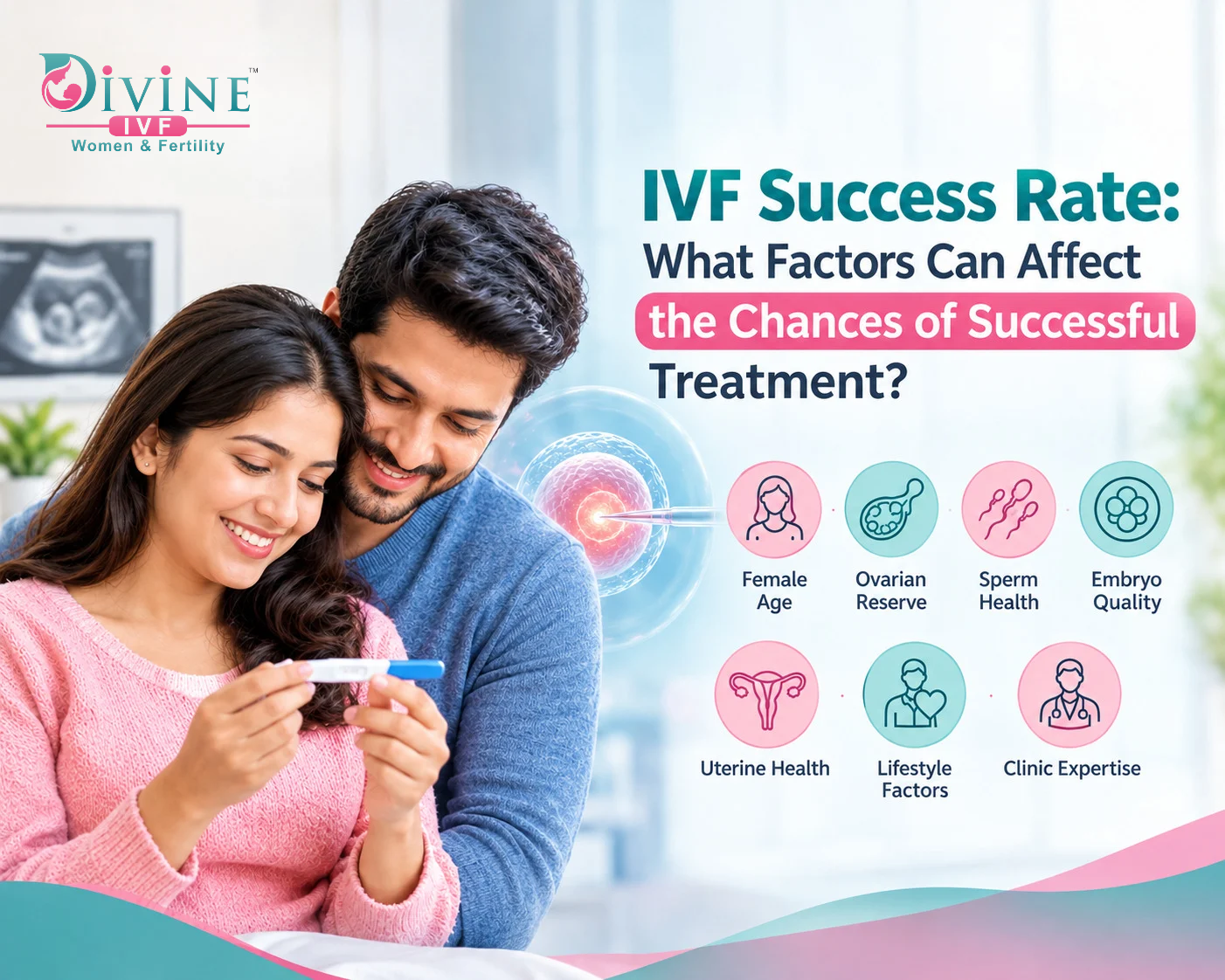
Success depends on multiple factors. Here is what matters most:
1. Age
Egg quality and quantity decline with age. This is the single biggest factor.
2. Ovarian Reserve
AMH levels and antral follicle count indicate how many eggs remain.
3. Sperm Health
DNA fragmentation, count, and morphology all play a role.
4. Uterine Health
A receptive endometrium is essential for implantation.
5. Lifestyle Factors
- Smoking, alcohol, and excessive caffeine reduce success
- Healthy weight improves outcomes
- Stress management supports treatment
6. Clinic & Lab Quality
An advanced IVF lab with experienced embryologists makes a measurable difference. Divine IVF's 70–80% overall success rate reflects this commitment to quality.
What to Expect Emotionally & Physically
IVF is a medical journey — but it is also an emotional one. Here is what many patients experience:
Physically
- Mild bloating during stimulation
- Light cramping after egg retrieval
- Fatigue from hormonal changes
Emotionally
- Hope mixed with anxiety
- Waiting periods that feel long
- Need for support from partner, family, or counsellor
At Divine IVF, counselling and emotional support are part of the care plan — because fertility is never just a report.
💬 "Our IVF journey was made much easier with the guidance and support of the medical team. Every step was explained clearly, which gave us confidence throughout the process."
— Priya & Rohit Sharma, Divine IVF patients
IVF vs IUI: What's the Difference?
| Feature | IUI | IVF |
|---|---|---|
| Procedure | Sperm placed in uterus | Eggs fertilised in lab |
| Invasiveness | Minimal | More involved |
| Success Rate | Lower | Higher |
| Best For | Mild infertility | Severe/complex infertility |
| Cost | Lower | Higher |
If IUI has not worked after 3 cycles, IVF is often the next recommended step.
Why Choose Divine IVF, Noida?
Choosing the right clinic is one of the most important decisions in your fertility journey. Here is what sets Divine IVF apart:
1. Doctor-Led Care
Every plan is shaped directly by Dr. Mandavi Rai — not a rotating team.
2. 15+ Years of Experience
Including 8+ years as Centre Head at Indira IVF, with a fellowship in Reproductive Medicine from NUS Singapore.
3. Individualised Evaluation
Investigations tailored to your history — not a one-size-fits-all protocol.
4. Male + Female Assessment Together
Fertility is evaluated for both partners, as it should be.
5. Advanced Reproductive Options
From IUI to ICSI, PICSI, IMSI, ERA, PGT, and PRP/LIT therapy.
6. Clear Communication
Every step explained in plain language — with room for your questions.
7. Ethical, Transparent Care
No unnecessary treatments. No hidden costs. Just honest guidance.
8. Complete Fertility Hub
Fertility evaluation, IUI, IVF, genetic testing, male infertility, gynaecology, and pregnancy care — all under one roof.
Credentials at a Glance
- MBBS — Bharati Vidyapeeth University, Pune
- M.S. OBGY — MGM Institute of Health Sciences, Mumbai
- Fellowship, Reproductive Medicine — CREST, NUHS, Singapore
- PG Diploma, Sexual & Reproductive Medicine — University of South Wales, UK
- M.MAS, Minimal Access Surgery — Gold Medalist
Frequently Asked Questions (FAQs)
1. What is IVF treatment?
IVF (In Vitro Fertilisation) is a fertility treatment where eggs are retrieved from the ovaries, fertilised with sperm in a lab, and the resulting embryo is transferred to the uterus. The process typically takes 4–6 weeks per cycle.
2. Who is eligible for IVF?
IVF is recommended for couples with blocked fallopian tubes, male factor infertility, endometriosis, ovulation disorders, unexplained infertility, recurrent IVF failure, or those who haven't had success with other treatments.
3. How long does one IVF cycle take?
A full IVF cycle typically takes about 4–6 weeks, from ovarian stimulation to embryo transfer. This includes 8–14 days of hormone injections, egg retrieval, fertilisation, and embryo transfer 3–5 days later.
4. Is IVF painful?
Most steps are well tolerated. Egg retrieval is done under light sedation, and embryo transfer is painless. Mild bloating or cramping may occur but usually settles quickly.
5. What is the difference between IUI and IVF?
IUI involves placing sperm directly into the uterus during ovulation, while IVF involves fertilising eggs outside the body in a lab. IVF is more involved and has higher success rates, especially for severe infertility cases.
6. What is the success rate of IVF at Divine IVF?
Divine IVF reports a 70–80% overall success rate, with 78% for women under 30 and 67% for ages 30–35. Individual results depend on age, ovarian reserve, sperm health, and other factors.
7. How much does IVF cost in Noida?
Costs vary based on the protocol, medications, and additional techniques (ICSI, PGT, etc.). Divine IVF offers 100% transparent pricing — you will receive a clear estimate after your consultation.
8. Can IVF help if I've had failed cycles before?
Yes. Dr. Mandavi Rai specialises in recurrent IVF failure, using advanced tools like ERA, PGT, PRP, and LIT therapy to address underlying causes.
Conclusion: Your Next Step Starts With a Conversation
IVF treatment is not just a medical procedure — it is a journey of hope, science, and personalised care. Understanding the process, eligibility, timeline, and what to expect empowers you to make informed decisions with confidence.
If you have been waiting for the right time or the right guidance, let this be your sign.
At Divine IVF, Sector 76, Noida, Dr. Mandavi Rai and her team are ready to walk this path with you — with honesty, expertise, and compassion.
🌟 Your dream of parenthood starts with the right care.
📍 Divine IVF, Sector 76, Noida
📞 Book your consultation today