
Normal Vaginal Delivery in Noida Personalised vaginal birth planning, labour care and pregnancy delivery
Looking for normal delivery Consult Dr. Mandavi Rai at Divine IVF for vaginal birth planning, labour care, pain relief and personalised pregnancy care.
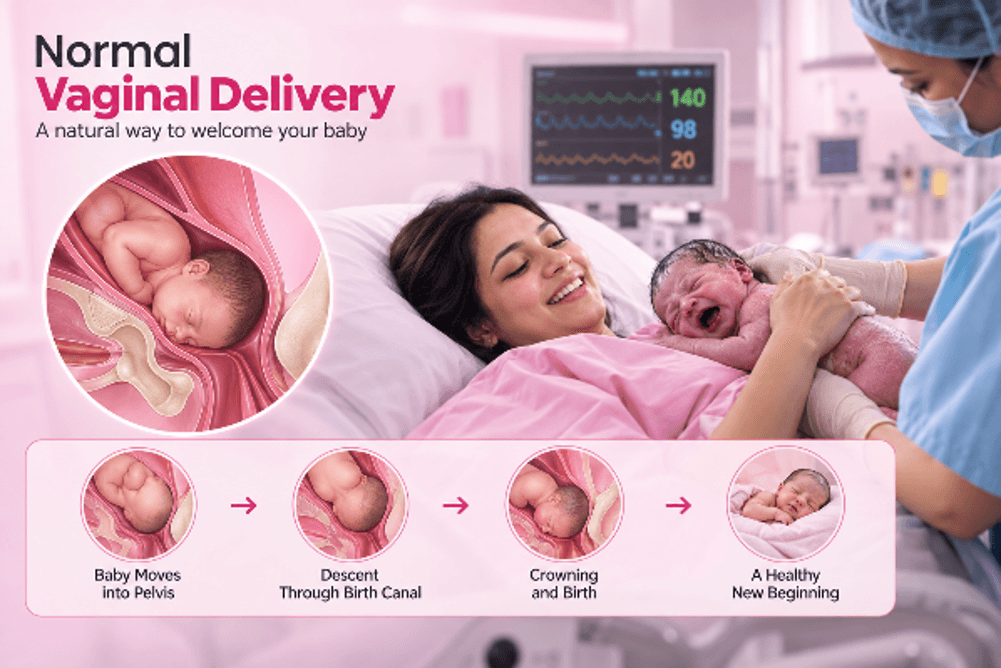
What is Normal Vaginal Delivery?
Normal vaginal delivery refers to labour and birth occurring through the birth canal, without surgical intervention, when both mother and baby are progressing well. This is the most common and natural way to give birth, allowing the body to work with its own physiological processes.
During a vaginal delivery, labour progresses through three stages: early labour and dilation of the cervix (first stage), pushing and delivery of the baby (second stage), and delivery of the placenta (third stage). Dr. Mandavi Rai monitors labour progress closely throughout, supporting a physiological delivery while remaining ready to adjust the plan if circumstances change.
At Divine IVF, Sector 76, Noida, normal vaginal delivery is provided with the same thorough, compassionate care that defines all aspects of pregnancy care. Dr. Rai respects your birth preferences while prioritising the safety of both you and your baby.
How it works
Labour Assessment
You're assessed on arrival to confirm labour progress — including cervical dilation, contractions, and the baby's position and wellbeing.
Continuous Monitoring
Both you and your baby are monitored throughout labour. The fetal heart rate is monitored, and your contractions and progress are assessed regularly.
First Stage of Labour
The cervix dilates from 0 to 10 centimetres. This stage is divided into early labour and active labour, with contractions becoming stronger and more frequent.
Second Stage of Labour (Delivery)
You're fully dilated and begin pushing to deliver your baby. This stage can last from a few minutes to several hours, depending on various factors.
Third Stage of Labour
After your baby is born, the placenta is delivered. This usually happens within 5-30 minutes after the baby's birth.
Immediate Postnatal Care
Care continues for both you and your baby immediately after birth — including skin-to-skin contact, breastfeeding support, and monitoring of both mother and baby.
Benefits
- Generally shorter recovery than surgical delivery — most women can return to normal activities within a few weeks
- A physiological process, supported rather than routinely intervened upon — working with your body's natural processes
- Less invasive than cesarean delivery — no surgical incisions, less bleeding, and lower risk of infection
- Earlier bonding and breastfeeding — immediate skin-to-skin contact is possible immediately after birth
- Shorter hospital stay — typically 1-2 days, compared to 2-4 days for cesarean delivery
- Lower risk of complications in future pregnancies — vaginal birth is generally safer for future pregnancies than multiple cesareans
- Empowering experience — many women find vaginal birth a powerful and positive experience
Things to know
- Labour can be unpredictable — plans may need to adapt in real time based on how labour progresses
- Not every labour progresses toward a vaginal delivery, and a change of plan is sometimes medically necessary for the safety of you or your baby
- Discussed and planned together in advance where possible, while remaining flexible to medical needs
- Pain management preferences should be discussed in advance — there are various options available
- Some women experience perineal tears or episiotomy during vaginal delivery, which may require stitches
- You'll need to be prepared for the possibility of an unplanned cesarean if labour doesn't progress as expected
- Recovery from vaginal birth includes postpartum bleeding, perineal discomfort, and hormonal changes
Getting ready
As your due date approaches, it's worth discussing your birth preferences with Dr. Rai, including pain relief options and who you'd like present, so the care team understands your priorities in advance. This conversation helps ensure your preferences are respected while keeping safety as the top priority.
Knowing the signs of labour and when to come in is covered in your later pregnancy visits, so you feel prepared rather than uncertain when the time comes. Signs of labour include regular contractions, rupture of membranes (your water breaking), and changes in vaginal discharge.
Consider packing a hospital bag with comfortable clothing, toiletries, items for your baby, and anything that will help you feel more at ease during labour — such as music, a pillow, or relaxation aids.
If you're planning to use a birth partner, bring them to the later pregnancy visits so they can understand the process and how they can support you during labour.
Consider attending antenatal classes to learn about breathing techniques, relaxation methods, and what to expect during labour and delivery.
What to expect
Labour duration and experience vary widely between individuals — there's no 'normal' when it comes to how long labour takes. For first-time mothers, labour typically lasts 8-18 hours; for subsequent pregnancies, it's often shorter. Dr. Rai and the care team monitor progress continuously and will discuss any changes to the plan with you as they arise. You'll have access to pain relief options including breathing techniques, TENS machines, gas and air, and epidural anaesthesia if needed. Throughout the process, you'll be supported by a caring team who respect your preferences and prioritise your safety.
Normal Vaginal Delivery in Noida
Personalised vaginal birth planning, labour care and pregnancy delivery at Divine IVF, Sector 76, Noida.
📍 Sector 76, Noida, Uttar Pradesh
📞 Call: +91 7678451808
What Is Normal Vaginal Delivery?
Normal vaginal delivery refers to labour and birth occurring through the birth canal, without surgical intervention, when both mother and baby are progressing well. This is the most common and natural way to give birth, allowing the body to work with its own physiological processes.
During a vaginal delivery, labour progresses through three stages:
- First Stage (Labour) — The cervix dilates from 0 to 10 centimetres, with contractions becoming stronger and more frequent
- Second Stage (Delivery) — You`re fully dilated and begin pushing to deliver your baby
- Third Stage (Placental Delivery) — After your baby is born, the placenta is delivered
Dr. Mandavi Rai monitors labour progress closely throughout, supporting a physiological delivery while remaining ready to adjust the plan if circumstances change.
When Should You Consider Normal Delivery?
Normal vaginal delivery may be appropriate when:
The decision is made in consultation with Dr. Rai, based on your pregnancy progress and health status.
The Three Stages of Labour
First Stage — Labour
The cervix dilates from 0 to 10 centimetres. This stage is divided into:
- Early Labour: Mild, irregular contractions; cervix dilates to about 3-4 centimetres
- Active Labour: Stronger, more frequent contractions; cervix dilates from 4 to 10 centimetres
This is typically the longest stage of labour, especially for first-time mothers.
Second Stage — Delivery
You`re fully dilated and begin pushing to deliver your baby. This stage can last from a few minutes to several hours. Dr. Rai and the care team will guide and support you through this stage.
Third Stage — Placental Delivery
After your baby is born, the placenta is delivered. This usually happens within 5-30 minutes and is typically the shortest and easiest stage.
Pain Relief Options During Labour
Various pain relief options are available during labour. Dr. Rai will discuss these options with you during your pregnancy, so you can make informed choices about what feels right for you.
Non-Medical Options
- Breathing and relaxation techniques
- Changes in position and movement
- TENS machines (electrical stimulation)
- Water therapy (availability varies)
- Massage and counter-pressure
- Support from a birth partner or doula
Medical Options
- Gas and air (Entonox) — inhaled nitrous oxide
- Epidural anaesthesia — regional pain relief
- Pethidine or other opioid pain relief
- Local anaesthesia (for episiotomy or suturing)
The choice of pain relief depends on your preferences, the stage of labour, and medical considerations.
Benefits of Normal Vaginal Delivery
- ✓ Shorter recovery timeMost women can return to normal activities within a few weeks
- ✓ Less invasive than cesareanNo surgical incisions, less bleeding, and lower risk of infection
- ✓ Earlier bondingImmediate skin-to-skin contact is possible immediately after birth
- ✓ Shorter hospital stayTypically 1-2 days, compared to 2-4 days for cesarean delivery
- ✓ Lower risk of complications in future pregnanciesVaginal birth is generally safer for future pregnancies than multiple cesareans
- ✓ Empowering experienceMany women find vaginal birth a powerful and positive experience
Important Considerations
What Happens If Labour Doesn`t Progress?
If labour doesn`t progress as expected, Dr. Rai will discuss your options with you. This may involve:
- Additional monitoring of you and your baby
- Interventions to help labour progress (such as amniotomy or oxytocin)
- If necessary — a change of plan to cesarean delivery
You`ll be kept informed throughout and involved in all decisions.
Can I Have a Vaginal Delivery After a Previous Cesarean?
In many cases, vaginal birth after cesarean (VBAC) is possible and safe. The decision depends on:
- The reason for your previous cesarean
- The type of incision used
- Your current pregnancy and health status
Dr. Rai will discuss your options and the risks and benefits with you.
Preparing for Normal Delivery
Discuss Your Birth Preferences
As your due date approaches, discuss your birth preferences with Dr. Rai, including pain relief options and who you`d like present. This conversation helps ensure your preferences are respected while keeping safety as the top priority.
Know the Signs of Labour
Knowing the signs of labour and when to come in is covered in your later pregnancy visits. Signs of labour include regular contractions, rupture of membranes (your water breaking), and changes in vaginal discharge.
Pack Your Hospital Bag
Consider packing comfortable clothing, toiletries, items for your baby, and anything that will help you feel more at ease during labour — such as music, a pillow, or relaxation aids.
Involve Your Birth Partner
If you`re planning to use a birth partner, bring them to the later pregnancy visits so they can understand the process and how they can support you during labour.
Consider Antenatal Classes
Attending antenatal classes can help you learn about breathing techniques, relaxation methods, and what to expect during labour and delivery.
Normal Delivery After IVF
Many women who conceive through IVF go on to have normal vaginal deliveries. The mode of delivery depends on your pregnancy progress, fetal position, and any obstetric factors — not on the method of conception. Dr. Rai will provide the same compassionate, high-quality care for your delivery regardless of how you conceived.
Normal Delivery Cost in Noida
The cost of normal delivery in Noida varies depending on several factors:
- Hospital or birthing facility chosen
- Duration of hospital stay
- Pain relief options used
- Any additional medical care required
- Assisted delivery if needed (vacuum or forceps)
- Postnatal care for mother and baby
Dr. Rai can provide more information about what to expect during your consultation.
Why Choose Divine IVF for Normal Delivery
- ✓Personalised Pregnancy and Delivery Care — Your birth preferences are respected while safety remains the top priority.
- ✓Comprehensive Labour Monitoring — Continuous monitoring of both mother and baby throughout labour and delivery.
- ✓Pain Relief Options — A range of pain relief options available, discussed in advance to suit your preferences.
- ✓Care Under Dr. Mandavi Rai — Your obstetrician is present throughout labour and delivery, providing continuity of care.
- ✓Evidence-Based Practice — Care follows guidelines from ACOG, FOGSI, and WHO for safe, high-quality delivery care.
- ✓Convenient Location in Sector 76, Noida — Easy access for patients in Noida and surrounding areas.
Book a Normal Delivery Consultation in Noida
If you are planning a normal vaginal delivery and want compassionate, personalised pregnancy care in Noida, Dr. Mandavi Rai at Divine IVF is here to support you. From birth planning to labour care and postnatal support, you`ll receive the highest quality care for you and your baby.
Divine IVF · Sector 76, Noida, Uttar Pradesh
Resources
Common questions
Yes — Dr. Rai encourages this conversation well before your due date, while remaining clear about when medical circumstances may require a different approach. Your birth preferences are respected, but safety is always the top priority.
Labour duration varies widely. For first-time mothers, labour typically lasts 8-18 hours. For subsequent pregnancies, it's often shorter. The second stage (pushing) can last from a few minutes to several hours. Every labour is different, and Dr. Rai will monitor your progress continuously.
Various pain relief options are available, including breathing techniques, TENS machines, gas and air (Entonox), and epidural anaesthesia. Dr. Rai will discuss these options with you during your pregnancy, so you can make informed choices about what feels right for you.
In many cases, vaginal birth after cesarean (VBAC) is possible and safe. The decision depends on the reason for your previous cesarean, the type of incision, and your current pregnancy. Dr. Rai will discuss your options and the risks and benefits with you.
If labour doesn't progress as expected, Dr. Rai will discuss your options with you. This may involve additional monitoring, interventions to help labour progress, or — if necessary — a change of plan to cesarean delivery. You'll be kept informed throughout.
Most women stay in hospital for 1-2 days after a vaginal delivery, depending on your recovery and any specific needs. You'll be discharged when both you and your baby are well and you're comfortable managing at home.
Dr. Rai can discuss your preferences for labour and delivery, including the possibility of a water birth or other comfort measures. The availability of specific birth options may vary, and Dr. Rai will help you understand what's possible for your specific pregnancy.
Yes — it's completely normal to feel nervous or scared about giving birth. Dr. Rai and the care team are here to support you, answer your questions, and help you feel as prepared and confident as possible. You're not alone in this journey.
The cost of normal delivery varies depending on the hospital, duration of stay, pain relief options used, and any additional medical care required. Dr. Rai can provide more information about what to expect during your consultation.
Yes. Many women who conceive through IVF go on to have normal vaginal deliveries. The mode of delivery depends on your pregnancy progress, fetal position, and any obstetric factors — not on the method of conception.
Ready to talk to Dr. Mandavi Rai?
Bring your questions, your history, and your pace — we`ll build the next step together.