
Intralipid Therapy in Noida Understanding intralipid infusion as a fertility treatment add-on for selected patients undergoing IVF or fertility care
If you have experienced repeated unsuccessful embryo transfers, recurrent pregnancy loss, or have been advised to explore immune-related fertility treatment add-ons, you may have come across Intralipid Therapy.
What is Intralipid Therapy?
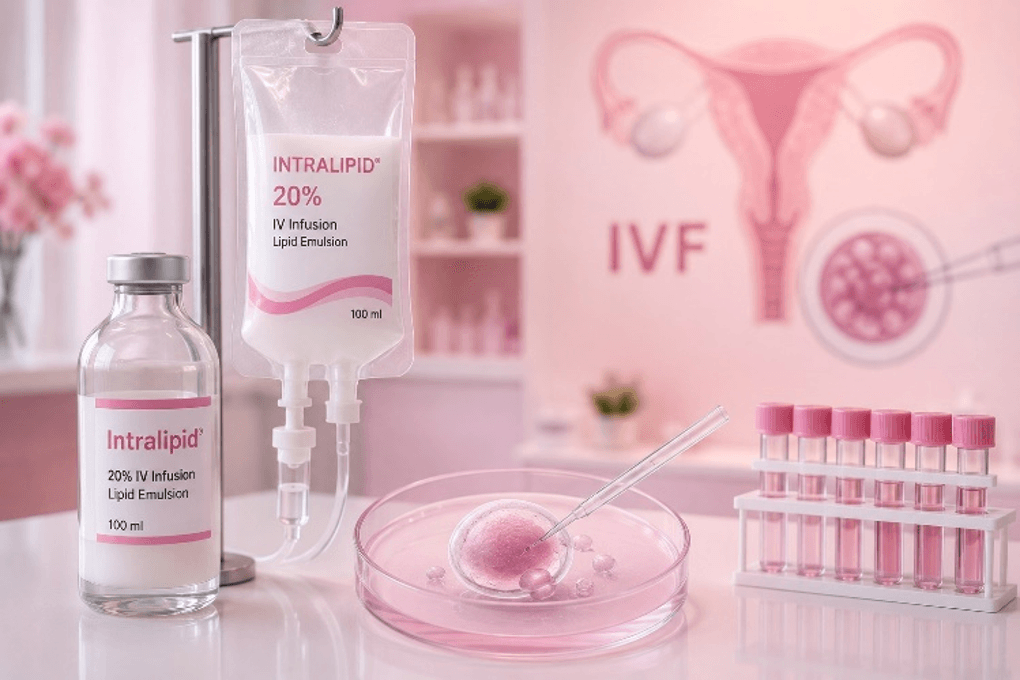
Intralipid is an intravenous fat emulsion originally developed for nutritional support. It generally contains components such as soybean oil, egg phospholipids, glycerol, and water.
In some fertility settings, intralipid infusion has been explored as an immune-modulating treatment add-on. However, its role in improving implantation, pregnancy or live-birth outcomes remains uncertain.
At Divine IVF, Sector 76, Noida, fertility treatment planning is based on your complete reproductive history, previous IVF cycles, embryo-transfer outcomes, medical conditions and available scientific evidence. Intralipid therapy is not a routine fertility treatment and should only be considered after an individual medical assessment and discussion of its potential benefits, limitations and risks.
How it works
Step 1 – Fertility Consultation
The doctor reviews fertility history, previous IVF cycles, previous embryo transfers, pregnancy-loss history, medical history, medications, and known allergies.
Step 2 – Review of Previous IVF Records
Previous treatment records can help identify potential reasons for unsuccessful cycles including embryo quality, embryo stage, number of transfers, endometrial findings, ovarian response, semen parameters, and genetic testing results.
Step 3 – Medical Suitability Assessment
Before intravenous treatment, the doctor assesses whether there are any contraindications or allergy risks.
Step 4 – Intravenous Infusion
Intralipid is administered intravenously through a drip. The dose, dilution and infusion duration vary according to the medical protocol.
Step 5 – Monitoring
Patients are monitored during infusion for possible reactions.
Step 6 – Follow-Up
Further fertility treatment proceeds according to the individual IVF or embryo-transfer plan.
Benefits
- Considered in specific, individually evaluated cases where immunological factors may be contributing
- Administered under clinical supervision with proper monitoring
- May offer an additional approach for patients who have experienced recurrent implantation failure or recurrent pregnancy loss
- Relatively well-tolerated with a generally favourable safety profile
- Can be integrated into a broader, individualised treatment plan
Things to know
- Not appropriate or necessary for every patient — only considered after thorough evaluation
- Its use should follow a proper evaluation, not be requested as a standalone add-on without clinical indication
- Discussed openly, including what is and isn't established about its role in your specific case — the evidence base is still evolving
- May not be effective for all patients, and response can vary
- Requires intravenous administration in a clinical setting with time commitment
- Costs associated with the therapy should be discussed upfront
- Potential side effects include mild fever, chills, headache, nausea, dizziness, flushing, injection-site discomfort, or allergic reactions (rare)
Getting ready
Before considering intralipid therapy, Dr. Rai reviews your fertility and pregnancy history in detail — including any previous IVF cycles, pregnancy outcomes, and relevant medical conditions. Specific immunological investigations may be recommended first to establish whether the therapy is relevant to your case.
No special preparation is needed on the day of the infusion itself beyond arriving for a routine intravenous infusion appointment. The infusion is timed around your fertility treatment cycle — typically before embryo transfer or in early pregnancy, depending on your individual plan.
You should inform the clinic of any allergies, particularly to soy, eggs, or any medications. Special caution may be required in people with soy allergy, egg allergy, peanut-related allergy concerns, previous severe allergic reactions, certain metabolic disorders, significant liver or lipid-metabolism disorders, or certain infections.
What to expect
An intralipid infusion typically takes 1-3 hours to administer in a supervised clinical setting. You'll be seated comfortably while the intravenous drip runs, and a nurse will monitor your vital signs throughout. Most patients tolerate the infusion well, though some may experience mild side effects. Dr. Rai will explain the specific timing and monitoring plan for your situation, including how the therapy fits into your overall treatment schedule.
Intralipid Therapy in Noida
Understanding intralipid infusion as a fertility treatment add-on for selected patients undergoing IVF or fertility care.
📍 Sector 76, Noida, Uttar Pradesh
📞 Call: +91 7678451808

What Is Intralipid Therapy?
Intralipid is an intravenous fat emulsion originally developed for nutritional support.
It generally contains components such as:
- Soybean oil
- Egg phospholipids
- Glycerol
- Water
In some fertility settings, intralipid infusion has been explored as an immune-modulating treatment add-on.
However, its role in improving implantation, pregnancy or live-birth outcomes remains uncertain.
What Is Intralipid Therapy in IVF?
Intralipid therapy in IVF refers to giving an intravenous lipid emulsion before or around fertility treatment or embryo transfer.
It has been proposed that intralipids may influence certain immune responses involved in implantation.
However, the relationship between immune-cell activity and IVF failure is complex, and current research has not established that intralipid infusion reliably improves fertility outcomes.
Therefore, intralipid therapy should not be considered a standard part of every IVF treatment cycle.
Why Is Intralipid Therapy Discussed in Fertility Treatment?
Intralipid therapy has mainly been explored in patients with:
However, these situations can have many different causes. A comprehensive fertility evaluation is more important than automatically adding immune therapies.
What Is Recurrent Implantation Failure?
Recurrent implantation failure refers broadly to repeated failure to achieve implantation after embryo transfer, although definitions vary.
Possible contributing factors may include:
Because implantation is influenced by many factors, treatment should focus first on identifying potentially correctable causes.


Intralipid Therapy and Natural Killer Cells
One of the reasons intralipid therapy has been proposed in fertility treatment relates to Natural Killer (NK) cells.
NK cells are part of the immune system and are also naturally present in the uterus.
Some theories have suggested that abnormal immune-cell activity may interfere with implantation. However:
For this reason, fertility treatment should not be based only on an abnormal immune test without broader clinical assessment.
Is Intralipid Therapy Proven to Improve IVF Success?
At present, there is insufficient high-quality evidence to say that intralipid therapy reliably improves the chance of having a baby for most fertility patients.
Some smaller studies have suggested possible benefits, while other evidence remains inconsistent or limited.
Therefore:
Who May Be Considered for Intralipid Therapy?
A fertility specialist may discuss intralipid therapy in selected cases, although routine use is not established.
Repeated IVF Failure
Patients who have experienced multiple unsuccessful IVF cycles may seek additional treatment options. However, embryo quality, uterine factors, sperm factors and treatment protocol should be reviewed first.
Repeated Implantation Failure
After repeated unsuccessful embryo transfers, a detailed review should be performed before considering treatment add-ons.
Recurrent Pregnancy Loss
Recurrent miscarriage may have several possible causes. Evaluation can include uterine factors, chromosomal causes, hormonal conditions, medical disorders, antiphospholipid syndrome where clinically indicated, and other reproductive factors. Intralipid therapy is not an established routine treatment for unexplained recurrent miscarriage.
Selected Immune-Related Concerns
Some fertility clinics may discuss intralipid treatment after immune-related investigations. However, current evidence for many fertility immunology tests and treatments remains limited.
Who Should Not Receive Intralipid Therapy Without Careful Assessment?
Intralipid infusion may not be appropriate for every patient. Special caution may be required in people with:
A complete medical history should always be reviewed before intravenous treatment.
When Is Intralipid Given During IVF?
There is no universally accepted intralipid protocol for fertility treatment. Different fertility settings have used intralipid:
Because protocols vary and evidence is limited, there is no single scientifically established schedule suitable for every patient.
Risks and Side Effects of Intralipid Therapy
Like any intravenous infusion, intralipid therapy can cause side effects.
Possible effects may include:
Less common but potentially serious complications may include:
For this reason, intralipid should only be administered under appropriate medical supervision.
Benefits Claimed for Intralipid Therapy
Some fertility literature and clinics have proposed that intralipids may:
However, these potential benefits have not been conclusively established through high-quality evidence. Patients should distinguish between a proposed mechanism and a proven clinical benefit.
Intralipid Therapy Cost in Noida
The cost of intralipid therapy in Noida may depend on:
Because protocols vary, the exact cost can only be discussed after clinical assessment. Patients should also ask whether the proposed treatment has evidence of benefit for their specific condition before paying for fertility add-ons.
Questions to Ask Before Choosing Intralipid Therapy
Before undergoing intralipid infusion, consider asking:
These questions can help you make an informed fertility-treatment decision.
Why Choose Divine IVF for Fertility Evaluation
- ✓Individualised Treatment Planning — Treatment decisions are based on each couple`s fertility history rather than automatically adding optional therapies.
- ✓Review of Previous IVF Failures — Previous treatment cycles can be reviewed to identify potential causes of unsuccessful implantation.
- ✓Male and Female Fertility Assessment — Fertility evaluation considers factors involving both partners.
- ✓IVF and Advanced Fertility Care — Depending on your diagnosis, appropriate evidence-based fertility treatment options can be discussed.
- ✓Doctor-Led Fertility Care — Treatment planning is provided under the guidance of Dr. Mandavi Rai, Gynecologist & IVF Specialist in Noida.
- ✓Convenient Location in Noida — Divine IVF is located in Sector 76, Noida, for patients seeking fertility consultation, IVF treatment and evaluation after previous treatment failure.
Book a Fertility Consultation in Noida
If you have experienced repeated unsuccessful embryo transfers, recurrent pregnancy loss, or previous IVF failure, the priority is to understand the possible cause before adding additional treatments. At Divine IVF, Sector 76, Noida, Dr. Mandavi Rai provides personalised fertility evaluation and IVF treatment planning based on your individual reproductive history.
Divine IVF · Sector 76, Noida, Uttar Pradesh
Resources
Common questions
Intralipid therapy involves intravenous administration of a fat emulsion. It has been explored as an immune-related fertility treatment add-on in some IVF settings.
It has been proposed that intralipids may influence immune activity involved in implantation, but this potential fertility benefit has not been conclusively proven.
There is currently insufficient high-quality evidence to confirm that intralipid therapy improves IVF live-birth rates for most patients.
Routine intralipid therapy is not currently supported by sufficient evidence for recurrent implantation failure.
There is insufficient evidence to recommend intralipid therapy routinely for preventing unexplained recurrent pregnancy loss.
Natural Killer cells are part of the immune system and are naturally present in the uterus. Their role in fertility is complex and not fully understood.
Not necessarily. Immune tests used in fertility treatment have important limitations and should not alone determine treatment.
Different protocols have used it at different times, but there is no universally accepted fertility protocol.
Possible side effects include headache, nausea, dizziness, flushing and infusion-related reactions. Rarely, serious allergic reactions can occur.
Patients with relevant allergies, particularly to components such as soybean or egg products, or certain medical conditions may not be suitable.
No. Intralipid is a fat emulsion, while IVIG contains immunoglobulins obtained from donated plasma.
Cost varies according to the product, dose, number of infusions, monitoring and associated fertility treatment.
You can consult Dr. Mandavi Rai at Divine IVF, Sector 76, Noida to review your fertility history and discuss whether any treatment add-on is medically appropriate.
Ready to talk to Dr. Mandavi Rai?
Bring your questions, your history, and your pace — we`ll build the next step together.